
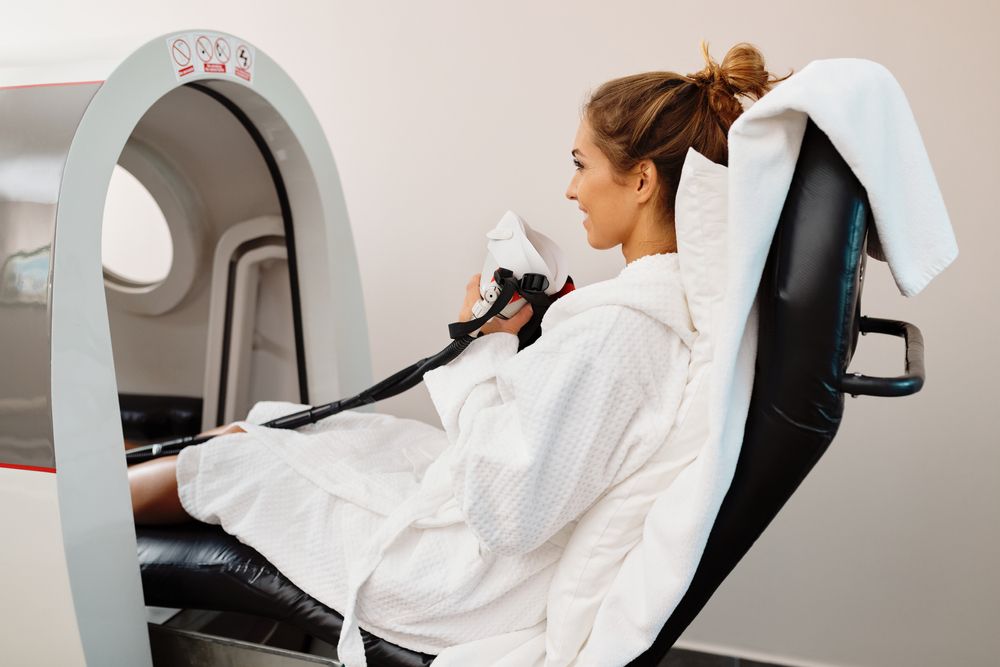
Mild hyperbaric oxygen therapy (mHBOT) is an emerging therapy being used to support recovery in people dealing with concussion, traumatic brain injury (TBI), neurological injuries, chronic inflammation, metabolic dysfunction, fatigue, and complex multi-system conditions.
At Axon Integrative Health in Denver, we use mild hyperbaric oxygen as part of a broader brain-body-mind recovery strategy—not as a stand-alone treatment.
The reason is simple:
The brain is an energy-demanding organ. Recovery requires oxygen, blood flow, mitochondrial function, cellular repair, inflammation control, and neuroplasticity.
mHBOT may influence several of these systems simultaneously.
What Is Mild Hyperbaric Oxygen Therapy?
Hyperbaric oxygen therapy uses increased atmospheric pressure to increase the amount of oxygen available to the body’s tissues.
At normal atmospheric pressure, we breathe approximately 21% oxygen. Most oxygen is carried by hemoglobin in the blood.
When pressure increases, more oxygen can dissolve directly into the plasma. This creates a larger oxygen diffusion gradient that can help oxygen reach tissues that may have impaired circulation, inflammation, edema, or altered metabolism.
This is one of the fundamental physiological principles behind hyperbaric oxygen therapy.
Traditional medical HBOT generally uses a hard-sided chamber and near-100% medical-grade oxygen at substantially higher pressures. The Undersea and Hyperbaric Medical Society (UHMS) distinguishes this from lower-pressure “mild hyperbaric” exposure.
What is mHBOT?
Mild hyperbaric oxygen therapy generally refers to treatment at lower pressures—commonly around 1.3–1.5 ATA—with oxygen concentrations that may be closer to room air or moderately enriched oxygen, depending on the chamber.
This is substantially different from conventional hospital-based HBOT.
At Axon, we view mHBOT as a physiological conditioning and recovery tool, rather than attempting to replicate the high-pressure oxygen doses used in hospital hyperbaric medicine.
Why Would Oxygen Help the Brain?
The brain represents only a small percentage of total body weight, yet it consumes a disproportionately large amount of the body’s oxygen and energy.
Following a concussion or neurological injury, several things can happen simultaneously:
- Brain energy demand can increase
- Cerebral blood flow can become dysregulated
- Mitochondrial ATP production can become less efficient
- Neuroinflammation can increase
- Oxidative stress can increase
- Neurovascular coupling can become impaired
- Cognitive processing can become less efficient
- Sleep and autonomic regulation can become disrupted
This creates a potential mismatch:
The injured brain may need more energy to recover while having a reduced ability to efficiently produce and deliver that energy.
This is sometimes described as an energy crisis following traumatic brain injury.
HBOT is being investigated because it may influence several of these mechanisms simultaneously, including cerebral blood flow, mitochondrial function, inflammation, oxidative signaling, angiogenesis, and neuroplasticity.
The 6 Major Physiological Effects of mHBOT
Rather than thinking about oxygen therapy simply as “getting more oxygen,” it is more useful to understand the biological signals created by pressure and oxygen exposure.
1. Increased Oxygen Availability
Increasing atmospheric pressure increases the amount of oxygen dissolved in plasma.
This can increase the oxygen gradient between blood and tissues.
For tissues experiencing impaired oxygen delivery, this may provide additional substrate for cellular metabolism and repair.
This is particularly interesting in neurological conditions because neurons have very high metabolic demands.
2. Mitochondrial Support
Mitochondria are the energy-producing structures inside our cells.
The brain relies heavily on mitochondrial ATP production to support:
- neuronal signaling
- ion gradients
- neurotransmission
- membrane repair
- cellular transport
- synaptic plasticity
- cognitive processing
Research examining HBOT’s neurological effects has identified changes involving mitochondrial function and ATP production, along with pathways associated with cellular survival and neuroplasticity.
This makes oxygen therapy particularly interesting for conditions in which brain energy metabolism may be impaired.
3. Neuroinflammation Modulation
Inflammation is not inherently bad.
Acute inflammation is part of normal healing.
The problem occurs when inflammatory signaling becomes prolonged or poorly regulated.
Persistent neuroinflammation can influence:
- cognition
- mood
- sleep
- pain sensitivity
- autonomic function
- fatigue
- sensory processing
HBOT research has identified effects on inflammatory signaling, including reductions in inflammatory cytokines in experimental models and changes in inflammatory pathways associated with neurological recovery.
This is one reason oxygen-based therapies are being investigated for chronic neurological and inflammatory conditions.
4. Cerebral Blood Flow & Neurovascular Function
The brain requires continuous and highly regulated blood flow.
After concussion, TBI, or other neurological injuries, cerebral blood flow and neurovascular regulation may become abnormal.
HBOT has been studied for its potential effects on cerebral perfusion and brain microstructure.
The proposed mechanism is not simply “more oxygen equals more blood flow.”
Instead, pressure and oxygen may influence the neurovascular environment, oxygen diffusion, vascular signaling, inflammation, and tissue metabolism.
These effects may create a more favorable environment for rehabilitation and neuroplasticity.
5. Angiogenesis & Tissue Repair
HBOT may also stimulate biological pathways involved in tissue repair.
Research has identified changes involving pathways such as:
- VEGF
- endothelial signaling
- angiogenesis
- neurogenesis
- synaptogenesis
- growth factors
These mechanisms are particularly interesting in neurological rehabilitation because recovery is not simply about “healing damaged neurons.”
The nervous system must also reorganize.
That process is called neuroplasticity.
HBOT has therefore been investigated as a potential way to create a more favorable biological environment in which rehabilitation and neuroplasticity can occur.
6. Cellular Signaling & Hormesis
One of the most interesting concepts surrounding hyperbaric oxygen is hormesis.
A controlled physiological stressor can stimulate adaptive cellular responses.
Oxygen is necessary for life—but excessive oxygen can also create oxidative stress.
The goal of therapeutic oxygen exposure is not simply to maximize oxygen.
It is to provide an appropriate dose that creates useful biological signaling without excessive oxidative injury.
This is one reason pressure, oxygen concentration, treatment duration, and treatment frequency matter.
Mild HBOT for Concussion & Post-Concussion Syndrome
Concussion is a form of mild traumatic brain injury.
Although conventional imaging may appear normal, concussion can still disrupt brain metabolism, blood flow, autonomic regulation, vestibular function, visual processing, and cognitive performance.
Symptoms can include:
- brain fog
- headaches
- dizziness
- fatigue
- light sensitivity
- sound sensitivity
- poor sleep
- anxiety
- irritability
- memory problems
- concentration difficulties
- exercise intolerance
- autonomic symptoms
HBOT has been studied extensively enough in TBI that the evidence deserves a nuanced interpretation.
A 2022 systematic review and dosage analysis identified multiple randomized and randomized-controlled studies examining HBOT for persistent post-concussion symptoms. The authors reported positive cognitive and/or symptomatic findings in several studies, particularly at 1.5 ATA, while results were inconsistent at other pressure and oxygen doses.
Importantly, other systematic reviews have reached more conservative conclusions, particularly because some sham-controlled trials found improvements in both HBOT and control groups.
That is why at Axon we don’t view oxygen therapy as a “magic chamber.”
Instead, we consider:
HBOT/mHBOT + neurological assessment + targeted rehabilitation + metabolic support + sleep + exercise + autonomic regulation
to be a more rational approach to complex concussion recovery.
What Does the Newest TBI Research Show?
A 2025 systematic review and meta-analysis examining HBOT for neurocognitive deficits following TBI included four studies involving 250 patients.
The authors reported significant improvements in several cognitive domains, including:
- memory
- attention
- executive function
- information-processing speed
- general cognition
- motor skills
However, the authors also emphasized that larger, standardized clinical trials are still needed.
Even more recently, a 2026 systematic review and meta-analysis of eight randomized trials involving 570 adults with TBI found improvements in computerized cognitive performance, executive function/processing speed, memory, and sleep quality, while finding no significant benefit for several broader outcomes such as PTSD, neurobehavioral symptoms, or emotional distress.
This is an important distinction:
The evidence is promising, but HBOT should not be presented as a universally proven treatment for every symptom or every type of TBI.
Mild HBOT for Neurological Injuries
The potential applications extend beyond concussion.
Researchers are investigating HBOT in conditions involving:
- stroke recovery
- spinal cord injury
- traumatic brain injury
- post-stroke depression
- neurodegenerative disease
- chronic neurological dysfunction
- cognitive impairment
- peripheral nerve injury
The proposed mechanisms include effects on mitochondrial function, inflammation, cerebral blood flow, angiogenesis, neurogenesis, synaptogenesis, and neuroplasticity.
For neurological rehabilitation, this raises an important concept:
Oxygen may not “fix” the nervous system.
Instead, it may help create a more biologically favorable environment for the nervous system to adapt.
That distinction is critical.
Mild HBOT and Metabolic Health
The brain is not the only organ that depends on oxygen and mitochondrial function.
Skeletal muscle, liver, heart, and other tissues rely heavily on oxidative metabolism.
Research on mild hyperbaric oxygen has explored its effects on:
- glucose metabolism
- insulin signaling
- oxidative metabolism
- skeletal muscle
- metabolic syndrome
- hypertension
- mitochondrial function
A review of mild hyperbaric oxygen research reported improvements in metabolic parameters in animal models, including reductions in blood glucose, insulin, triglycerides, cholesterol, and blood pressure in models of metabolic syndrome. However, these findings should not be interpreted as proof that mHBOT treats metabolic disease in humans.
At Axon, this is why we think about oxygen therapy as part of a broader metabolic optimization strategy, rather than a replacement for nutrition, exercise, sleep, or medical care.
Mild HBOT, Mold Exposure & Biotoxins
One of the most interesting—and emerging—areas of mHBOT research involves complex environmental illness.
Patients exposed to environmental contaminants may report combinations of:
- fatigue
- brain fog
- headaches
- cognitive changes
- exercise intolerance
- sleep disruption
- sensory sensitivity
- inflammatory symptoms
- autonomic dysfunction
The biology of these conditions can be complex and is still being actively investigated.
The 2025 CIRS Case Report
The study you referenced is particularly interesting.
Published in Frontiers in Immunology in 2025, the case report described a patient with chronic inflammatory response syndrome who underwent 40 low-pressure HBOT sessions over 10 weeks at 1.3 ATA and 24% oxygen.
The patient reportedly experienced resolution of all 22 reported symptoms, improvement in visual contrast sensitivity from 68% to 93%, and reductions in inflammatory biomarkers including TGF-β1 and MMP-9.
The authors proposed that low-pressure HBOT may influence systemic inflammation and neurocognitive function.
But there is an important caveat:
This was one patient.
A case report can generate a hypothesis and demonstrate that an intervention deserves further study. It cannot establish that mHBOT causes the observed improvements.
Nevertheless, it is an intriguing finding because it specifically studied a low-pressure protocol similar to the type of chamber used in many wellness and integrative settings, rather than relying exclusively on conventional 2.0–3.0 ATA hospital HBOT.
Hard Chamber vs. Soft Chamber: What’s the Difference?
One of the biggest sources of confusion is the phrase “hyperbaric oxygen.”
Not every hyperbaric chamber delivers the same treatment.
Hard-Sided Medical Hyperbaric Chamber
Traditional medical HBOT typically uses a rigid chamber capable of substantially higher pressures.
Common characteristics include:
- hard-sided construction
- approximately 2.0–3.0 ATA for many medical indications
- near-100% medical-grade oxygen
- physician-directed protocols
- specialized hyperbaric safety standards
- treatment typically lasting approximately 90–120 minutes
UHMS identifies conventional clinical HBOT as requiring near-100% medical-grade oxygen at elevated pressure, with its current guidance emphasizing hard-sided chambers and medical oversight.
These systems are used for established medical indications such as decompression sickness, carbon monoxide poisoning, certain wounds, radiation injuries, and other recognized conditions.
Soft-Sided / Mild Hyperbaric Chamber
Mild chambers generally operate at substantially lower pressures.
Common protocols are approximately:
1.3–1.5 ATA
depending on the device and clinical protocol.
Oxygen concentration also varies significantly.
Some systems use compressed air, while others supplement oxygen through a mask or other delivery system.
UHMS specifically distinguishes these lower-pressure treatments from conventional clinical HBOT.
Why does the difference matter?
Because:
1.3 ATA air is not physiologically equivalent to 2.0 ATA at 100% oxygen.
The oxygen dose is different.
The pressure is different.
The dissolved oxygen level is different.
The physiological stimulus is different.
Therefore, research on conventional HBOT cannot automatically be used to claim that every mild chamber produces the same results.
This is one of the most important distinctions consumers should understand.
Why Does Axon Use Mild HBOT?
At Axon, our approach is centered around precision medicine for the Brain–Body–Mind.
We are often working with patients who don’t have a single isolated problem.
Instead, they may have overlapping dysfunction involving:
Brain + metabolism + inflammation + autonomic regulation + movement + sleep + cellular energy
For these patients, the goal is often not simply to “treat a diagnosis.”
The goal is to improve the biological systems that allow recovery to occur.
We therefore may consider mHBOT alongside other interventions such as:
- neurological rehabilitation
- autonomic regulation
- targeted exercise
- metabolic support
- photobiomodulation
- neuromodulation
- vestibular rehabilitation
- visual rehabilitation
- cognitive training
- sleep optimization
- nutritional interventions
- functional medicine evaluation
The exact combination depends on the individual’s presentation.
Who Might Consider Mild HBOT?
At Axon, mHBOT may be considered as part of an individualized plan for people dealing with:
Neurological & Brain Conditions
- Concussion
- Persistent post-concussion symptoms
- Traumatic brain injury
- Stroke recovery
- Neurological rehabilitation
- Cognitive impairment
- Brain fog
- Exercise intolerance
Metabolic & Cellular Issues
- Reduced exercise capacity
- Metabolic dysfunction
- Mitochondrial stress
- Recovery from significant physiological stress
- Deconditioning
Complex Multi-System Conditions
- Chronic fatigue
- Long COVID
- Autonomic dysfunction
- Chronic inflammatory states
- Environmental illness / biotoxin-related illness
- Complex recovery cases
These applications vary considerably in their level of scientific evidence.
Some are supported by human clinical research.
Others are supported primarily by mechanistic, animal, preliminary, or case-report evidence.
That distinction matters.
What mHBOT Cannot Do
Mild hyperbaric oxygen therapy should not be viewed as a cure-all.
It does not replace:
- emergency medical care
- appropriate neurological evaluation
- concussion management
- physical rehabilitation
- nutrition
- exercise
- sleep
- treatment of underlying medical conditions
- appropriate environmental remediation
- conventional medical treatment when indicated
And it should not be used simply because “more oxygen is always better.”
Oxygen is a biological signal. Dose matters.
Is Mild HBOT Safe?
When appropriately administered, hyperbaric oxygen therapy is generally considered well tolerated, but it is not risk-free.
Potential adverse effects can include:
- ear or sinus pressure
- difficulty equalizing pressure
- temporary changes in vision
- claustrophobia
- oxygen-related adverse effects
- barotrauma
-, rarely, oxygen toxicity seizures
Device and facility safety are also extremely important.
In August 2025, the FDA issued a safety communication reminding healthcare providers about serious injuries and deaths associated with HBOT devices and emphasized fire prevention, staff training, monitoring, proper grounding, maintenance, and adherence to manufacturer instructions.
This is particularly important with oxygen-enriched environments.
A hyperbaric chamber is medical equipment—not simply a wellness pod.
The Axon Perspective: Oxygen Is Only One Piece of Recovery
One of the biggest mistakes in complex neurological recovery is looking for a single intervention.
The nervous system is an interconnected system.
A concussion can influence:
Blood flow → metabolism → inflammation → autonomic function → sleep → movement → cognition → mood
A similar interconnected pattern can occur in complex inflammatory or metabolic conditions.
That is why our approach focuses on three foundational objectives:
1. Improve Cellular Health
Support the ability of cells—especially neurons and mitochondria—to generate and use energy.
2. Modulate Inflammation
Identify and address factors contributing to persistent inflammatory signaling.
3. Enhance Neuroplasticity
Create the biological and behavioral conditions that allow the nervous system to adapt, reorganize, and recover.
mHBOT may fit into all three categories.
But the most important word is:
May.
The science is promising, but the correct protocol depends on the individual.
The Bottom Line
Mild hyperbaric oxygen therapy is an intriguing tool for neurological and whole-body recovery because it combines two physiological stimuli:
oxygen + pressure
These stimuli may influence oxygen delivery, mitochondrial function, inflammation, vascular signaling, tissue repair, and neuroplasticity.
The research surrounding concussion and TBI is growing. Recent systematic reviews suggest potential improvements in cognitive domains such as memory, attention, executive function, processing speed, and sleep, although study protocols vary and additional high-quality trials are needed.
Emerging research is also beginning to explore lower-pressure oxygen therapy in complex inflammatory conditions. The 2025 CIRS case report you referenced is an especially interesting example, although it remains preliminary evidence that needs replication.
At Axon, we believe the most useful question isn’t:
“Does hyperbaric oxygen work?”
The better question is:
“For this person, with this physiology, what biological systems are limiting recovery—and could oxygen and pressure be one piece of the solution?”
That is the foundation of a precision approach to brain and body recovery.
Frequently Asked Questions About Mild HBOT
What is mild hyperbaric oxygen therapy?
Mild hyperbaric oxygen therapy uses a pressurized chamber at lower pressures than conventional medical HBOT, commonly around 1.3–1.5 ATA. Oxygen concentration varies by device and protocol.
Is mild HBOT the same as hospital hyperbaric oxygen therapy?
No. Conventional medical HBOT generally uses a hard-sided chamber, substantially higher pressures, and near-100% medical-grade oxygen. Mild hyperbaric protocols use lower pressures and may use air or oxygen-enriched air.
Can mild HBOT help concussion?
Research suggests HBOT may improve some symptoms and cognitive domains in people with persistent post-concussion symptoms, but evidence remains mixed and protocols vary. It should be considered an adjunct to a comprehensive concussion rehabilitation program rather than a replacement for one.
Can HBOT help traumatic brain injury?
Recent systematic reviews suggest potential improvements in memory, attention, executive function, processing speed, and other cognitive measures following TBI, although more standardized randomized trials are needed.
Can mHBOT help brain fog and fatigue?
There is emerging evidence that hyperbaric oxygen may influence cognitive function, mitochondrial activity, inflammation, and cerebral physiology. However, brain fog and fatigue have many potential causes, so treatment should be individualized.
Can mild HBOT help mold or biotoxin-related illness?
Research is still preliminary. A 2025 case report described substantial improvement following 40 low-pressure HBOT sessions in a patient with CIRS, including improvements in symptoms, visual contrast sensitivity, TGF-β1, and MMP-9. However, a single case cannot establish treatment efficacy.
How many HBOT sessions are needed?
There is no universally established protocol for mild HBOT for concussion, TBI, CIRS, metabolic dysfunction, or other complex conditions. Treatment frequency and duration should be individualized based on the patient’s condition, response, and overall treatment plan.
Is HBOT FDA approved for concussion or CIRS?
Conventional HBOT has established FDA-cleared uses for certain medical conditions, but concussion, post-concussion syndrome, and CIRS should not be represented as established FDA-cleared indications for HBOT. The evidence for these applications remains investigational or adjunctive.
A Better Way to Think About HBOT
HBOT isn’t simply about putting more oxygen into the body.
It is about using oxygen and pressure as biological signals that may influence the environment in which healing occurs.
For the right patient, that may mean:
More oxygen availability → better cellular energy → improved tissue environment → reduced inflammatory signaling → greater capacity for neuroplasticity and rehabilitation.
The goal isn’t to replace the body’s healing processes.
The goal is to help create the conditions in which those processes can work better.